
Reproducible, Scalable Research Without Queues: A Climate Finance Case Study Using Nuvolos
Reproducibility by default.
Identical results across collaborators and time.
On-demand scale, no queues.
Interactive runs without cluster negotiations.
Lower coordination cost.
Shared, containerized Python + Stata environments.
As a PhD researcher in Finance, Flavio De Carolis faced familiar hurdles: merging tens of millions of rows, iterating difference-in-differences models, and aligning Python/Stata environments across collaborators. On local or queued systems, that meant slow cycles, dependency conflicts, and fragile reproducibility.
Using Nuvolos, he eliminated queue waits, ran scaled instances on demand, and shared a containerized, identical environment with co-authors, tightening iteration and making results reproducible by default.
Scaling Research Without Waiting in Queues: A Case Study with Nuvolos
This work was supported by the Nuvolos Fellowship Programme, fellows receive $5,000 in cloud credits, recognition, and a priority support channel.
Explore the Fellowship details →
From batch-queue friction to fluid iteration
Consider two real climate-finance projects:
- Local Institutional Ownership & Extreme Weather (co-authored with Rob Bauer & Dirk Broeders)
- SME Finance & Flood Resilience (co-authored with Vinzenz Peters)
Flavio De Carolis, PhD researcher in computational economics, faced practical hurdles that may sound familiar: merging tens of millions of rows, running repeated difference-in-differences loops, spatial mapping of facility-level data, and keeping code and environments aligned across collaborators working in Python and Stata. In traditional workflows, that often means long queue times, dependency conflicts, and broken reproducibility. and In traditional workflows, that often means long wait times, unpredictable dependencies, and fractured reproducibility.
See how to become a Nuvolos Fellow →
As part of the Nuvolos PhD Fellowship, Flavio moved his core research into Nuvolos and encountered a different reality, one where queues faded, collaboration tightened, and iteration sped up.
What Was Breaking Before
Flavio’s setbacks were not unique. Among them:
- Memory bottlenecks in large joins through fuzzy string matching: Matching ~22 million company names to another dataset (~45,000 entities) using a fuzzy string matching algorithm repeatedly taxed his local machines. Crashes, slowdowns, or chunked workarounds were common.
- Complex estimator computations: Running dynamic regressions, such as difference-in-differences deployments or event studies, required multiple loops of regressions that, on local or queued systems, forced him to wait for completion before diagnosing bugs.
- Cross-environment inconsistencies: Collaborators using different OSes or library versions often saw mismatches in results. Installing packages, aligning dependencies, or resolving Stata licensing delays were constant friction.
- Sharing via exports or zips: Exchanging code and data by email or file dump led to version confusion, missing dependencies, or manual “run instructions” that easily got lost.
- Lack of reproducibility guarantees: Because environment drift and manual steps slipped in, some results became difficult to re-run months later or by a secondary researcher.
Flavio recognized that productivity was eroded, not by complexity in methods or data, but by fragility in tooling.
How Nuvolos Changed the Workflow
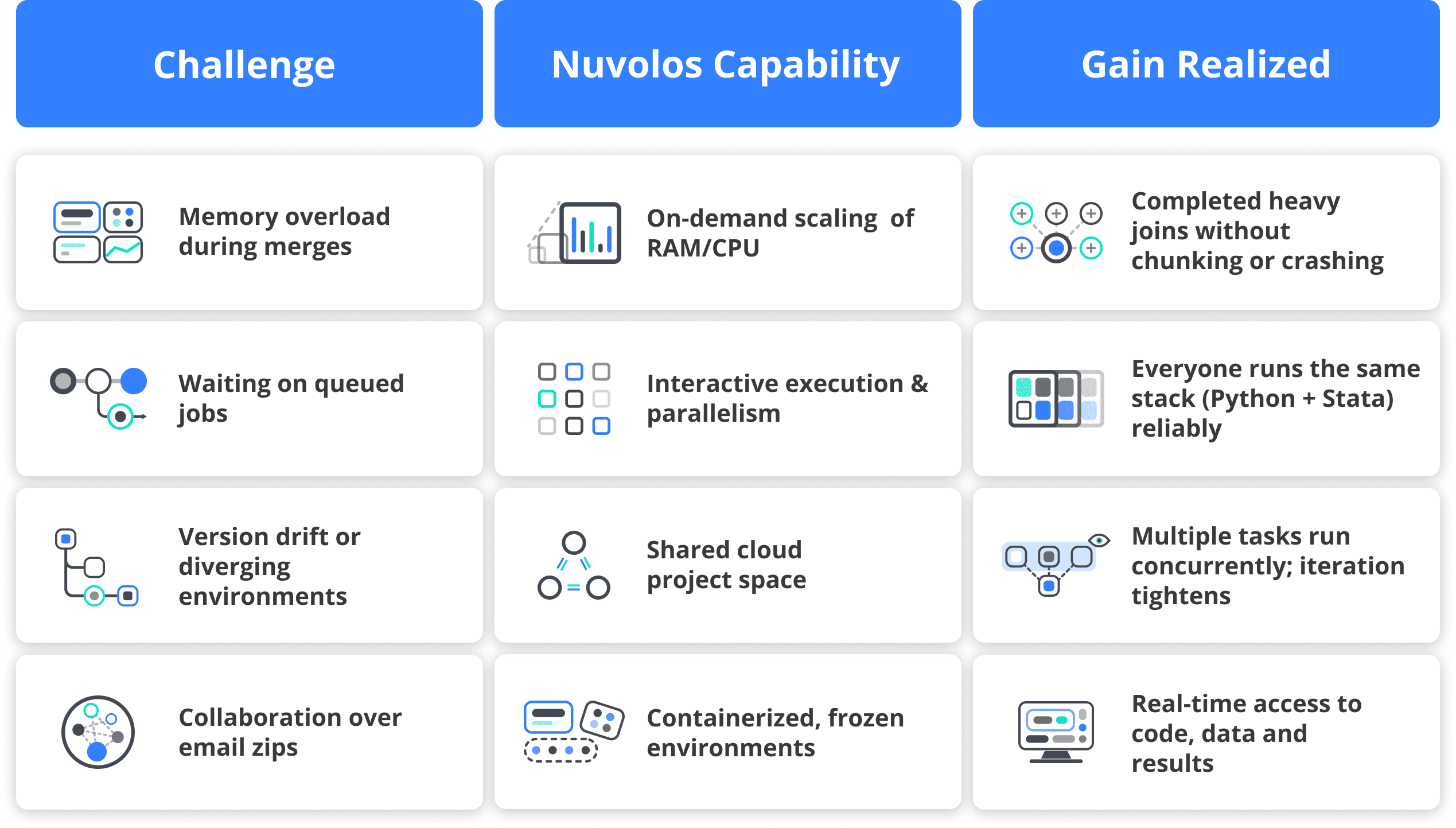
Here’s how specific Nuvolos features mapped to clear gains in Flavio's research:
Example in action
The 22-million-row name-matching job became a single task on a scaled instance. Errors surfaced immediately via logs; Flavio reran subsets in parallel and adjusted parameters in real time, no queues, no guesswork about memory limits.

Join the next cohort of Nuvolos Fellows advancing science! →
What This Actually Means (Beyond Hype)
Iteration speed mattered more than single-run speed.
Waiting days for a full model run is less efficient than getting partial results quickly, spotting bugs, and re-running. In practice, Flavio’s iteration loop shortened from multi-day to same-day cycles.
Trust and replicability become defaults.
Rather than second-guessing whether someone ran a different package version, his team could treat code as reproducible by design.
Scaling without infrastructure management.
Flavio didn’t need to negotiate cluster allocations, request more memory, or maintain servers. The infrastructure scaled transparently through Nuvolos.
Collaboration friction reduced.
Co-authors no longer had to decipher each other’s environment setup or installation steps. They could dive into results immediately, test variants, and reproduce analyses step by step.
Observations, Trade-offs, and Caveats
- HPC still has its place. For extremely large MPI or GPU-scale simulations, traditional cluster methods may remain necessary. Nuvolos is not meant to replace those, but to complement them for interactive, iterative research.
- Dependency on cloud access. Researchers working under strict data-governance regimes or firewalled environments may face integration challenges.
- Quotas & cost management. While scaling is convenient, unmanaged resource allocation can lead to budget surprises. Best practice: institute usage caps or monitoring from day one.
- Access to confidential data (e.g. central bank datasets). Some high-security environments will not allow third-party platform access. Flavio flagged this as a limitation in his context, and those cases require tailored integration.
Even with those caveats, the net improvement in fluid workflow and reproducibility was judged by Flavio to be meaningful and sustained.
Takeaway for Computational Researchers
If you spend hours babysitting jobs, undoing dependency mismatches, or reassembling colleagues’ exports, your tooling is your bottleneck, not your methods, not your data, and not your creativity. Flavio’s case shows that shifting the infrastructure burden to a cloud-native, reproducible platform can restore your focus to science rather than plumbing.
Join a cohort of peers building serious pipelines without reinventing DevOps!
If you’re working on computationally intensive research and want a chance to test this workflow yourself, you can apply to the Nuvolos PhD Fellowship at https://nuvolos.com/fellowship-programme.