
REDCap Runs Inside Nuvolos. Here's What That Changes for Clinical Research Teams.

REDCap now runs inside Nuvolos on sovereign infrastructure, every study isolated from the next, audit-ready for 25 years, and provisioned without a central IT ticket.
Read more
Why reticulate Breaks in R + Python Containers, and the Fix That Actually Holds
Most mixed R + Python containers look fine until reticulate crashes with GLIBCXX_3.4.32 not found, or silently returns wrong numbers. The cause is structural, not a bug. Here's what's actually happening and the fix.
Read more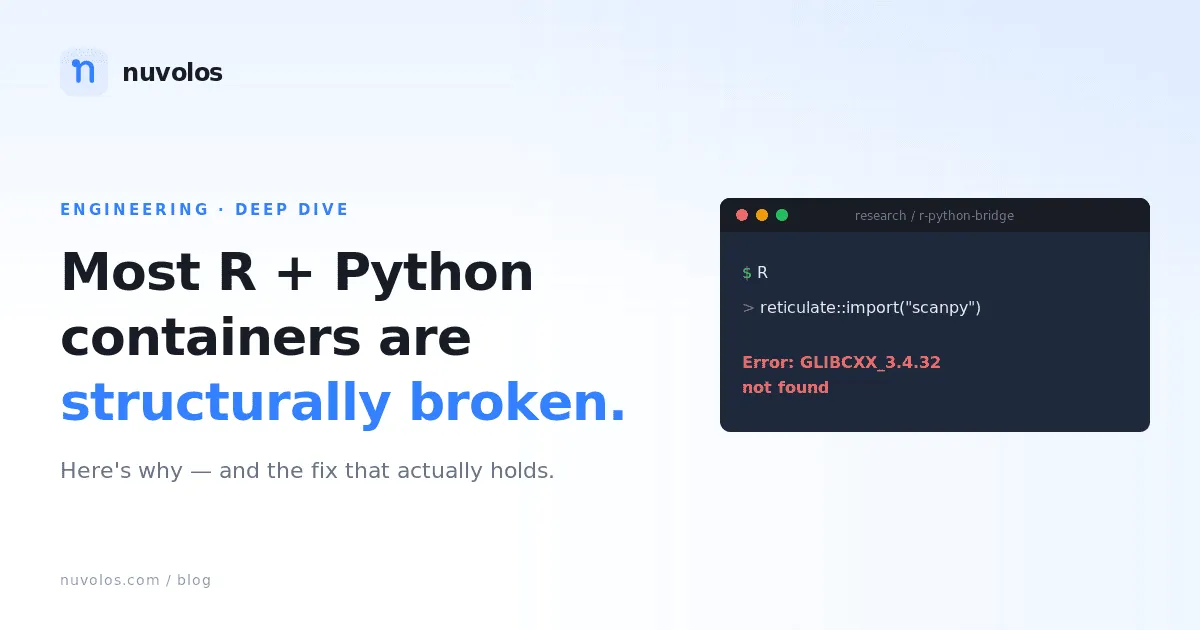
Cloud Computing in Education: Reclaiming Control of Scientific Infrastructure
The modern university thinks in code. Research, teaching, and collaboration flow through cloud infrastructure that defines the rhythm of discovery itself. Cloud computing in education isn’t about servers or software, it’s about how knowledge moves. When governed with intent, it restores what scholars value most: clarity, continuity, and time to think.
Read more
Rethinking HPC: Stop Forcing Science to Fit the System
Today’s researchers need fast, interactive workflows—but most academic HPC systems are still optimized for batch jobs and static stacks. This post challenges that model, showing how early-stage experimentation is being constrained by infrastructure friction—and what IT leaders can do to bridge the gap between discovery and scale without disrupting their current infrastructure.
Read more
AI in Drug Discovery: Reshaping the Pharmaceutical Landscape and the Imperative for Transformation
AI in Drug Discovery is advancing faster than ever — but without human transformation, the tech alone won't deliver. Real impact doesn’t come from AI alone, but from how effectively it's integrated with scientific expertise and operational workflows to fully leverage its potential in R&D.
Read more
How Can Universities Support Students Using Their Own Devices in Digital Labs?
BYOD (Bring Your Own Device) is becoming the new normal in academia around the globe. While it promises flexibility and cost savings, it often leads to fragmented setups and barriers in computational teaching and research. This shift, however, points to a broader transformation: academia is moving toward cloud-native tools and environments that support scalable and reproducible workflows.
Read more