
Why reticulate Breaks in R + Python Containers, and the Fix That Actually Holds

Monday morning, a computational biology postdoc joins the lab. By Thursday, they've imported scanpy into R via reticulate::import("scanpy") to bridge an existing Seurat pipeline with a newer Python analysis. By Friday, R is crashing with GLIBCXX_3.4.32 not found
This pattern is one of the most common and least talked-about failure modes in modern computational research. It comes down to a structural mismatch between how R is shipped, how Python is shipped, and how the Linux dynamic linker actually works. Here is what's happening, why the obvious fixes don't work, and how we engineered around it in Nuvolos.
What reticulate actually does
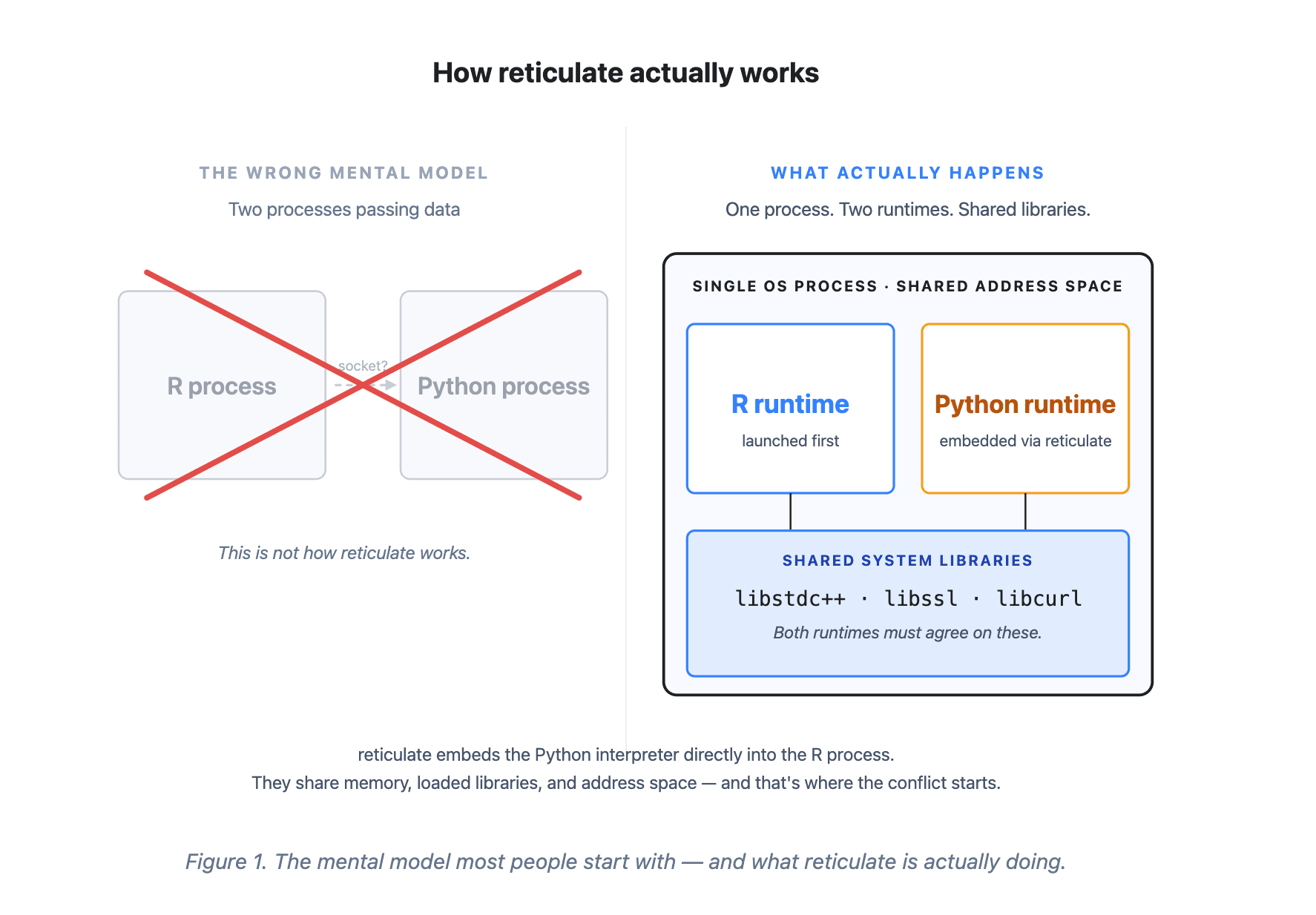
Most people assume reticulate works by spawning a Python process and passing data between R and Python over a socket or pipe. It doesn't. reticulate embeds the Python interpreter directly into the running R process. Same memory. Same loaded libraries. Same address space.
That detail matters. R and Python are no longer two programs talking to each other. They are two language runtimes sharing one operating-system process. Everything that runs inside that process, including system libraries like libstdc++libssllibcurl
This is where the trouble starts.
Why the standard recipe is structurally broken
The default way to build a mixed R + Python container looks like this:
- Start from a base Ubuntu image.
- Install R via
apt-get install r-base - Install Miniconda or Anaconda.
pip installconda install- Install
reticulate - Hope.
The hope is misplaced, for a reason that goes deeper than most R + Python tutorials acknowledge.
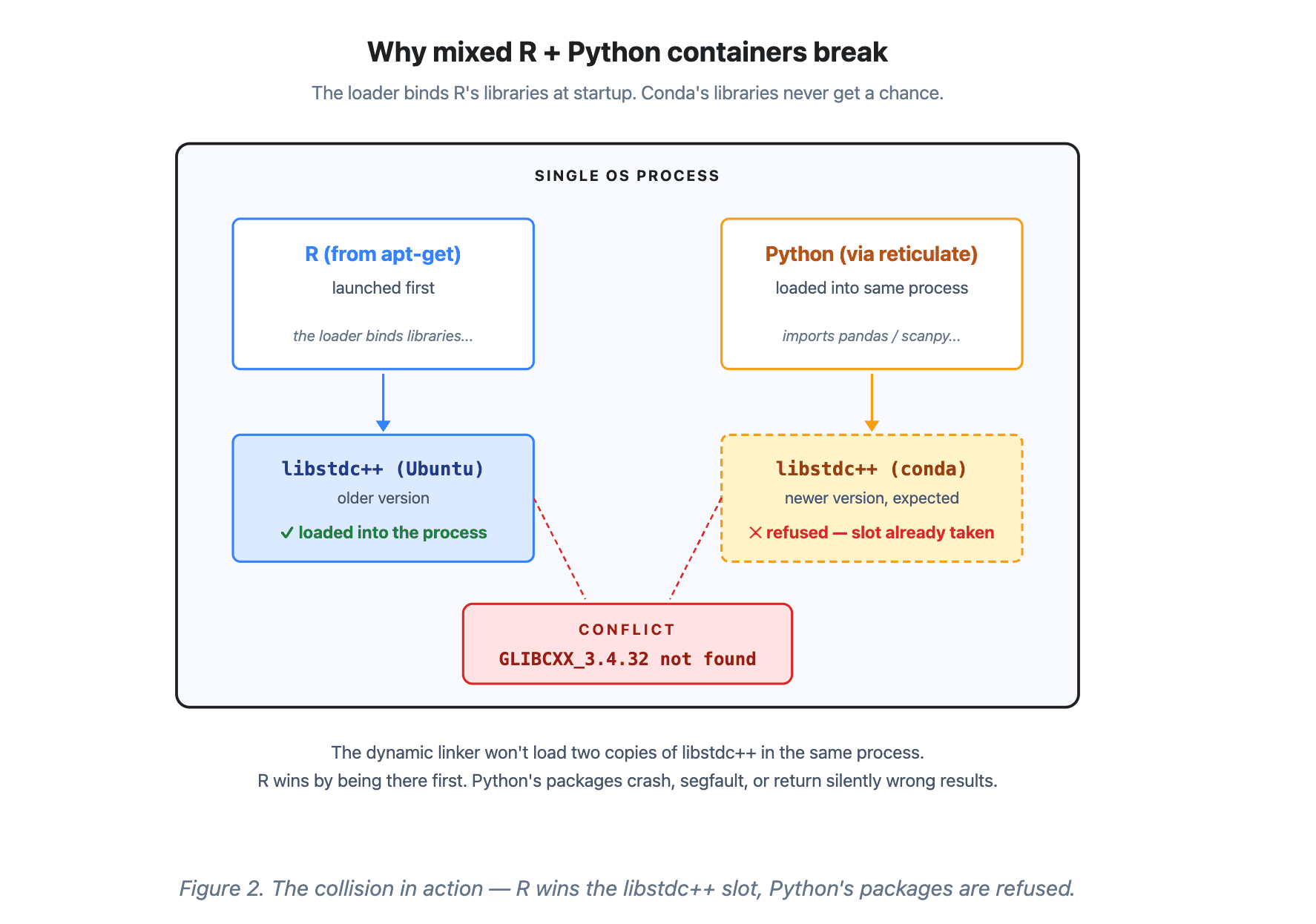
The R that Ubuntu ships is compiled against Ubuntu's versions of common system libraries. The exact versions of libstdc++libssllibcurl
From that moment, the library versions are locked in. They live in the process. Their symbols are resolved. Their memory layout is fixed.
Then reticulate loads Python into the same process. Python tries to import a conda-built package, pandas, scanpy, anything compiled in the conda-forge toolchain. That package was compiled against conda's newer libstdc++
But the libstdc++ slot in this process has already been filled by Ubuntu's older copy. The dynamic linker will not load a second libstdc++ alongside the first. The conda package gets handed the older library, finds the symbols it needs are missing or laid out differently, and one of three things happens:
- A loud crash.
version GLIBCXX_3.4.32 not found (required by libpandas.so) - A segmentation fault. Less obvious, harder to diagnose, but at least it stops.
- Silently wrong behavior. Rare in practice, but possible: two ABI-incompatible versions of a C++ library can disagree on exception handling, memory layout, or allocator behavior, producing subtle errors that surface only in edge cases.
The first failure mode is the most common. The third is the most worrying, because it doesn't announce itself.
Why LD_LIBRARY_PATH doesn't save you
The internet's most-recommended workaround is to set LD_LIBRARY_PATH lib/libstdc++
In practice, this papers over the symptom and creates a worse failure later. Two things go wrong:
Mid-process changes don't work. Once R is running and reticulate is about to load Python, it's too late. The loader has already chosen and bound R's libraries. You cannot tell a running process "actually, please re-resolve your C++ runtime against this other directory."
Pre-launch changes create ABI mismatches. If you set LD_LIBRARY_PATHlibstdc++
The deeper truth: the library that gets loaded into the process is the one R was compiled against. There is no runtime escape from a compile-time decision.
LD_LIBRARY_PATH papers over the symptom and surfaces a worse failure later. It is not a fix. It is a delayed bug.
The fix: compile R against conda's libraries
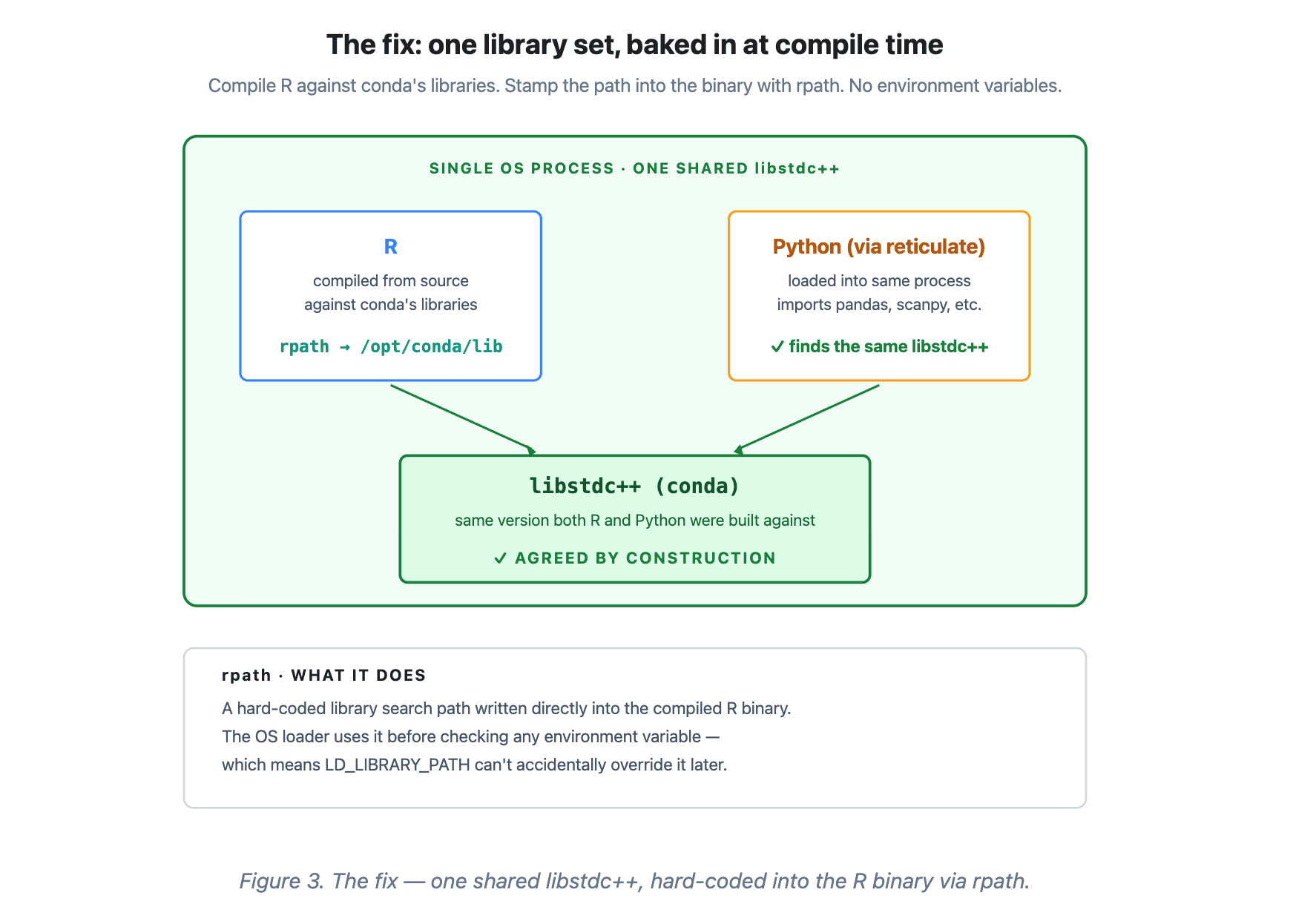
The honest answer is to refuse the conflict at its root. Here is what we do in Nuvolos:
- Install conda first. The base OS stays as lightweight as possible. All compile and link targets are managed by conda.
- Compile R from source against conda's libraries. Not Ubuntu's
libstdc++, but - Bake the conda library path into the R binary using rpath. The Linux linker supports a feature called
rpath
When R launches, it loads conda's libstdc++libstdc++
Every package a user later compiles in this environment inherits the same rpath. The system stays clean. Bash and the OS layer are untouched. The match between compile-time and runtime libraries is guaranteed by construction.
The second problem: researchers want to install things
A frozen environment isn't useful. Researchers want to install.packages("Seurat") pip install transformersconda install -c bioconda samtools
We support this by mounting the conda directory and the R library directory as a persistent volume, owned by the user from creation. No permission contortions. No "ask IT to rebuild the image."
This creates a new risk. A user can install something that pulls in an updated libssllibcurllibstdc++rpath still points to the right directory, but the files in that directory have shifted underneath it. The next R session, or the next package load, breaks in a way that is almost impossible to diagnose without already knowing this failure mode.
The defense: pinning the link-critical libraries
Inside the conda environment, we place a pinned file that lists every library R was built against. Conda's package solver respects this file: it will refuse to upgrade, downgrade, or move any of those packages, even as part of resolving a new install.
Users can install anything compatible with the pinned versions. They cannot, accidentally or otherwise, pull the rug out from under R. The freedom researchers want is preserved. The stability they rely on is defended.
What this means in practice
For the people doing real research, all of this is invisible. A computational biologist opens their workspace in a browser. They load Seurat, call reticulate::import("scanpy")
None of this requires the researcher to know about the dynamic linker, ELF rpath, conda-meta pinning, or ABI compatibility. It works because the infrastructure underneath was engineered to refuse the conflicts that normally surface at exactly the wrong moment in a project.
Why we built it this way
Mixed R + Python is one of the most common patterns in modern computational research, particularly in bioinformatics, single-cell genomics, quantitative finance, and any field where R has deep statistical libraries and Python has dominant ML tooling. The standard tooling, system R plus a conda Python, is structurally fragile, and the fragility tends to surface months into a project, when the cost of debugging is highest.
The lesson we keep coming back to: when two language runtimes share a process, they must share a single set of libraries, chosen and bound at compile time, not patched at runtime. And a user-owned, persistent dependency volume is only useful if you actively defend the parts the user must not be allowed to break.